
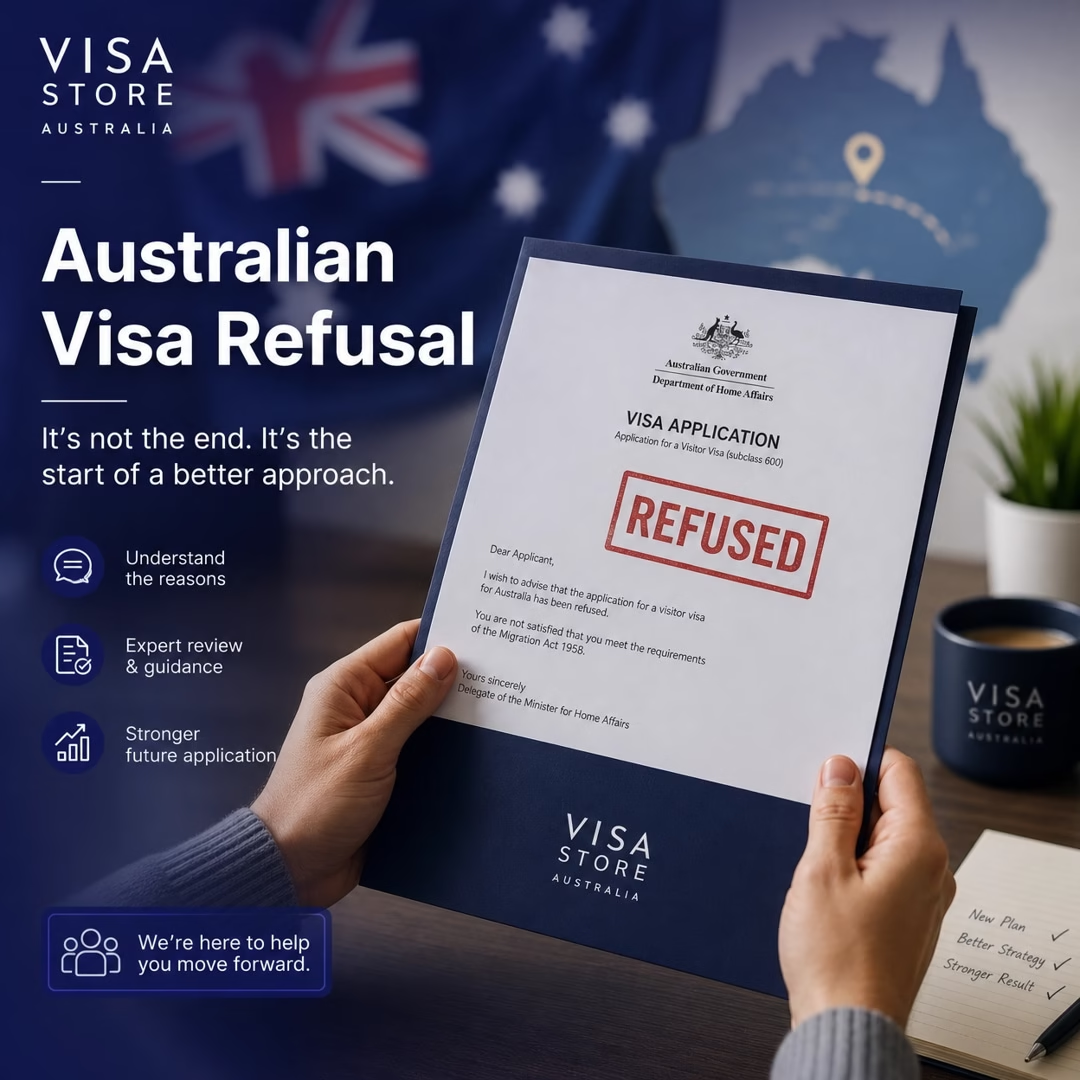
Most Australian visa refusals are avoidable. That is not a comforting thing to hear after the fact — but it matters enormously before you lodge. The Department of Home Affairs assesses every application against a defined set of legal criteria, and the reasons people fail those criteria repeat themselves across thousands of cases each year.
Whether you are researching before your first application, trying to understand why your application was rejected, or planning a reapplication — this guide covers the most common reasons for visa refusal in Australia and, more usefully, what you can do to prevent them.
Understanding What “Visa Refused” Actually Means
When the Department of Home Affairs refuses a visa application, it means a delegate was not satisfied that one or more criteria for that visa were met. The delegate is not looking for a reason to refuse — they are assessing whether the evidence in front of them is sufficient to approve.
That framing matters because it places the burden of proof squarely on the applicant. You do not get the benefit of the doubt. If the delegate cannot confirm that you meet a criterion — because the evidence is missing, unclear, or inconsistent — refusal is the outcome.
Your refusal letter (formally called the decision record) will state which specific criteria were not met and, in most cases, why the delegate was not satisfied. That document is the starting point for understanding what went wrong and what needs to change.
What follows are the most common reasons Australian visas are refused — and what you can do about each one.
Reason 1: Failure to Demonstrate Genuine Temporary Entry
This is the most common reason for visitor and student visa refusals, and it is the one that catches the most people off guard. The Genuine Temporary Entrant (GTE) requirement applies across most temporary visa types. The DHA must be satisfied that you genuinely intend to stay in Australia only for the authorised period and that you have real reasons to return home.
A case officer assessing genuine temporary entry is essentially asking: does this person have a life to return to?
The factors that feed into that assessment include your employment situation at home, your family ties, your property or financial commitments, your immigration history, and the consistency between your stated purpose and your personal circumstances.
A long requested stay with no clear employment, thin family ties, and no property in your home country will raise flags regardless of how strong your financial documents are.
What frequently triggers a GTE refusal:
- Vague or generic statements about the purpose of your visit
- No employment or education commitments in your home country
- Weak family or financial ties that would incentivise return
- A pattern of previous extended overseas travel
- Large, unexplained deposits in bank accounts just before lodging (fund parking)
- Inconsistency between your stated intentions and your personal background
How to avoid it:
- Write a specific, detailed statement of purpose that is grounded in your actual circumstances
- Provide evidence of employment (employer letter with leave approval, payslips, employment contract)
- Include proof of family ties — documents showing dependents, property, ongoing commitments at home
- If you have a complex personal situation that could appear ambiguous, address it directly rather than hoping the officer does not notice
Reason 2: Insufficient Financial Evidence
The DHA must be satisfied that you can support yourself — and any dependents — financially during your stay in Australia, without needing to work illegally or burden public services. Financial evidence is required for nearly every visa category.
The most common financial mistake is submitting a bank statement that shows a large recent deposit with no explanation of where the funds came from.
Delegates are experienced at identifying “fund parking” — the practice of moving money into an account shortly before lodging to inflate the apparent balance. Consistent income history, regular savings, and traceable sources of funds carry far more weight than a one-time large deposit.
What frequently triggers a financial evidence refusal:
- Bank statements that show sudden large deposits close to lodgement
- Funds that cannot be clearly traced to a legitimate source (employment, business income, property sale, inheritance)
- Outdated financial documents (most delegates want statements from the last three to six months)
- Insufficient funds relative to the requested visa duration
- A sponsor’s financial documents that are incomplete or do not demonstrate capacity to support the applicant
How to avoid it:
- Provide bank statements covering at least the last three to six months showing consistent patterns, not just a current balance
- Explain any large deposits clearly and include supporting documentation (sale of asset, inheritance letter, etc.)
- If someone is sponsoring you, include their financial documents, employment details, and a signed sponsorship declaration
- For student visas, the financial threshold is significant — as of 2025, you need to demonstrate access to approximately AUD $21,000 per year for living costs, on top of tuition fees
Reason 3: Incomplete, Incorrect, or Inconsistent Documentation
An application that cannot be verified is an application that will be refused. The DHA reviews every key document — and inconsistencies between forms, supporting documents, and previous visa records are treated as credibility concerns, not administrative oversights.
This is more common than applicants expect. A name spelled differently across two documents. Dates that do not align. An employment letter that contradicts bank statements. Certified translations that are missing or inadequate. These are not trivial matters — they undermine the reliability of the entire application.
What frequently triggers a documentation refusal:
- Missing mandatory documents (police clearances, certified translations, health examinations)
- Inconsistencies across documents — names, dates, employment history, travel history
- Documents that cannot be verified (invalid contact details for an employer, unoficial-looking bank statements)
- Failure to respond to a Request for Further Information within the 28-day window
- Using screenshots instead of official downloaded documents
How to avoid it:
- Use a document checklist for your specific visa subclass (the DHA’s website has subclass-specific guidance)
- Cross-check every document against every other document before lodging — names, dates, employer details, and stated facts must be consistent throughout
- Ensure all non-English documents are translated by a certified translator
- Monitor your ImmiAccount closely during processing and respond promptly to any requests — the clock starts the moment the request is issued
Reason 4: Failure to Meet Health Requirements
All visa applicants and their family members — including dependents who are not travelling — must meet Australia’s health requirements. These requirements exist to protect public health and manage the cost impact on Australia’s health and community services.
A Medical Officer of the Commonwealth assesses health-related refusals. The officer considers whether a condition is likely to pose a risk to public health or result in a significant cost to Australian health services — not whether the individual will actually use those services or can afford private treatment. Having private health insurance does not exempt you from the health requirement.
Conditions that commonly affect visa applications:
- Active tuberculosis (one of the most common health-related refusals globally)
- HIV in certain circumstances
- Significant mental health conditions requiring ongoing treatment
- Other conditions that are assessed as likely to require expensive or specialised care
How to avoid it:
- Complete all required health examinations with an approved panel physician — the DHA will notify you if examinations are required after lodgement
- If you have a known medical condition, seek professional advice before lodging to understand the likely impact and whether any waivers or exemptions may apply
- Do not delay health examinations once requested — unexplained delays in completing health checks can themselves lead to refusal
Reason 5: Failure to Pass the Character Test
Australia’s character test is set out under section 501 of the Migration Act 1958. Failing it can result in a visa being refused or an existing visa being cancelled. The character test is not limited to serious criminal convictions — it is broader than most applicants realise.
A person fails the character test if, among other things, they have a substantial criminal record (generally, a sentence of 12 months or more), have been involved in criminal organisations, present an ongoing risk to the Australian community, or have been involved in people smuggling, war crimes, or similar serious matters.
Separately, section 116 of the Migration Act gives the DHA power to cancel an existing visa on broader grounds — including breaching visa conditions, providing incorrect information, or when the holder’s presence is assessed as a risk to health, safety, or the good order of the community.
What frequently triggers a character-related refusal:
- Criminal convictions that were not disclosed in the application
- Convictions that were disclosed but where the assessment finds them too serious to overlook
- Previous visa breaches or overstays — in Australia or any other country
- Failure to provide required police clearances for all countries of residence
How to avoid it:
- Obtain police clearances for every country where you have lived for 12 months or more in the past 10 years — this is a standard DHA requirement for most visa subclasses
- Disclose all criminal history honestly — non-disclosure is treated as a separate, compounding character concern that often results in worse outcomes than the original offence
- If you have a criminal history, seek professional advice before lodging to understand the realistic impact and whether a character waiver is available
Reason 6: Providing False or Misleading Information — PIC 4020
This deserves its own section because the consequences are categorically more severe than any other refusal reason.
Public Interest Criterion 4020 (PIC 4020) applies when an applicant has provided bogus documents, or false or misleading information, in a visa application. A finding under PIC 4020 can result in a three-year bar from being granted most Australian visas. In the most serious cases — particularly where fraud is established — the bar can extend to ten years.
PIC 4020 is not triggered by an honest mistake on a form. It is triggered by deliberate misrepresentation. But the line between an unintentional error and a finding of false information can be contested, and the DHA will typically issue a notice inviting you to respond before a PIC 4020 finding is made.
What triggers PIC 4020:
- Submitting documents that have been altered, fabricated, or fraudulently obtained
- Making statements in your application that are knowingly false (false employment history, false relationship history, false financial position)
- Using false identity documents
- Failing to disclose previous visa refusals or cancellations
How to avoid it:
- Provide only genuine, unaltered documents
- Disclose all previous refusals across all countries — this is a legal requirement, and non-disclosure is frequently discovered through visa history cross-checks
- If you receive a PIC 4020 notice from the DHA, respond through a registered migration agent — your response to that notice determines whether the bar is applied
Reason 7: Visa Cancellation — When a Granted Visa Is Revoked
Visa cancellation is different from visa refusal, but it belongs in this discussion because many of the same underlying reasons apply. A visa can be cancelled after it has been granted if circumstances change, if the visa holder has breached conditions, or if information comes to light that was not known at the time of grant.
The most common grounds for cancellation under section 116 of the Migration Act include:
- Breach of visa conditions — for example, a student visa holder who drops below full-time enrolment, or a sponsored worker who changes employers without approval
- Incorrect information — if the DHA discovers that information provided in the original application was false, the visa can be cancelled even after it was granted
- Changed circumstances — where the reason the visa was granted no longer exists (for example, a relationship that formed the basis of a partner visa has ended)
- Risk to the community — section 116(1)(e) allows cancellation where the holder’s presence poses a risk to the health, safety, or good order of the Australian community
If you receive a Notice of Intention to Consider Cancellation (NOICC), you will generally have a short window to respond. Take that notice seriously — respond within the timeframe with as much relevant information as possible, and seek professional advice immediately.
If your visa has already been refused and you want to understand your next steps and appeal options, see: Options and next steps after Australian visa refusal
Reason 8: Wrong Visa Subclass for Your Circumstances
This is one of the most preventable causes of refusal and one of the most overlooked. Australia’s visa system contains dozens of subclasses, many with overlapping purposes but meaningfully different criteria.
Applying for the wrong subclass means you cannot meet the criteria — not because your circumstances are inadequate, but because the visa you chose does not fit those circumstances.
This happens most commonly when applicants self-assess their eligibility based on incomplete information, or when they use a visa subclass that worked for someone else without checking whether it applies to them.
Common examples:
- Applying for a Visitor visa (subclass 600) when a Family-Sponsored stream would better fit the application
- Applying for a Temporary Skill Shortage visa in the wrong stream
- Applying under one skilled visa pathway when a different pathway matches the applicant’s occupation and circumstances more precisely
How to avoid it:
- Check the specific eligibility criteria for every subclass you are considering — the DHA’s website has subclass-specific requirement pages
- If you are uncertain which subclass applies, that uncertainty is itself a reason to get professional advice before lodging, not after
The Pattern Underneath All of It
Reading across all these refusal reasons, a single thread runs through every one: the burden of proof is on you. The DHA does not fill gaps in your evidence. The delegate does not contact your employer to verify the letter you submitted. The officer does not give you the benefit of the doubt on an ambiguous financial statement.
A strong application is not simply one that includes the required documents. It is one where every document is consistent with every other document, where the overall picture is coherent and verifiable, and where potential concerns are addressed directly — not left for the delegate to interpret unfavourably.
That is a higher standard than most applicants realise going in. And it is why even applicants with strong genuine cases end up refused when their application does not do an adequate job of demonstrating what is actually true.
Frequently Asked Questions
Why was my visa refused in Australia?
Your refusal letter — formally called the decision record — will state the specific reasons. Common reasons include failure to demonstrate genuine temporary entry, insufficient financial evidence, incomplete or inconsistent documentation, health or character concerns, or false and misleading information. Read the letter carefully; the language used by the delegate tells you exactly what the DHA was not satisfied with.
Can a visa be refused for minor document errors?
Yes. While minor administrative errors alone rarely cause refusal, inconsistencies across documents — or a pattern of incomplete or unverifiable information — undermine the credibility of the application as a whole. The DHA may issue a Request for Further Information before refusing, but there is no guarantee.
Does a visa refusal affect future applications?
Every Australian visa application requires disclosure of previous refusals. A past refusal is not automatically disqualifying, but it becomes part of your immigration history. How it is managed — with a clear explanation of what has changed — determines its impact on future applications.
What is the GTE requirement and why does it cause so many refusals?
GTE stands for Genuine Temporary Entrant. It is the DHA’s assessment of whether you genuinely intend to stay in Australia temporarily and return home. It is one of the most commonly failed criteria for visitor and student visas because applicants underestimate how much evidence is needed to demonstrate real ties to their home country, not just a stated intention to return.
What is the difference between a visa refusal and a visa cancellation?
A refusal occurs before the visa is granted — the application is assessed and denied. A cancellation occurs after the visa has been granted — the DHA revokes it because conditions have been breached, incorrect information was provided, or circumstances have changed. Both can be serious, but they carry different legal consequences and different options for challenge or recovery.
Get It Right Before You Lodge
A well-prepared application is your best protection against refusal. If you are uncertain about any aspect of your eligibility, your documentation, or how the DHA will assess your circumstances — that uncertainty is the signal to get advice before you lodge, not after.
Our registered migration agents at Visa Store Australia review applications before lodgement, identify gaps and risks that are not always visible to applicants, and prepare submissions that address likely areas of concern directly.
Contact us to book a consultation before your next application — or to understand your options if a refusal has already been issued.
Related:
Deadlines and Options After Australian Visa Refusal