

491 Visa Requirements: Everything You Need to Know About Both Streams
Understand the full 491 visa requirements for both the state-nominated and 491 family sponsored visa streams, including points, eligibility, and the path to permanent residency.
MARN 2217857 - Perth-based registered migration agent. Check your eligibility →
0484 191 742Understand the full 491 visa requirements for both the state-nominated and 491 family sponsored visa streams, including points, eligibility, and the path to permanent residency.

A visa refusal in Australia does not automatically close the door. In most cases you can apply again — sometimes immediately. But the gap between a reapplication that succeeds and one that collects a second refusal is almost always preparation, not eligibility. The Department of Home Affairs has a record of your immigration history. They will review your new application knowing you were previously refused. What they are looking for is genuine change — different evidence, different circumstances, or a fundamentally stronger case. Not the same file lodged again. This guide covers how reapplication works across all major visa categories, what the DHA expects to see, when reapplying is the right move versus appealing, and what the process looks like for the visa types most commonly refused in Australia. Is There a Waiting Period Before You Can Reapply? For most Australian visa types, there is no mandatory waiting period. You can lodge a new application the day after you receive your refusal notice. The exceptions matter, so check your letter carefully. PIC 4020 bar — three years. If the DHA found that you provided bogus documents or false or misleading information, a finding under Public Interest Criterion 4020 results in a three-year bar from being granted most Australian visas. This is not triggered by an honest error — it applies to deliberate misrepresentation. If a PIC 4020 bar has been imposed, reapplication is not available until it lifts, unless a waiver applies in very limited circumstances. Section 48 bar — onshore applicants only. If your visa was refused while you were in Australia (onshore), section 48 of the Migration Act may prevent you from applying for most substantive visas while you remain in the country. Whether this applies depends on your visa type and how the refusal was made. It does not apply to all onshore refusals, but it is one of the main reasons professional advice matters before lodging again. Character-based restrictions. Some refusals or cancellations under section 501 (the character test) can carry conditions that affect your ability to reapply. The details will be in your refusal letter. Outside these scenarios, no waiting period applies. The real question is not whether you can apply — it is whether your new application is genuinely stronger than the one that was refused. Reapply or Appeal — Which Path Is Right? Before lodging a new application, the first decision is whether reapplication is even the right move. For some refusals, an Administrative Review Tribunal (ART) appeal is a stronger option. For others, reapplication wins on speed and cost. And for some, both are available — which is its own decision. Reapplying tends to be the better option when: Your visa type does not carry ART review rights (most offshore visitor visa refusals, for example) The refusal was caused by a clear evidentiary gap you can now fill — updated financial documents, corrected forms, a stronger GTE or GS statement Your circumstances have genuinely changed since the original application The ART review timeline (median 18 months) and fee ($3,580) make it impractical relative to the visa at stake Pursuing an ART appeal tends to be the better option when: Your decision is a reviewable migration decision (your refusal letter will state this) The DHA’s reasoning appears to contain an error of fact or a procedural fairness issue Reapplication is restricted by a Section 48 bar and you cannot leave Australia to lodge offshore The visa type is high-stakes — partner visa, employer-sponsored visa, permanent residency — where merits review gives you the most complete opportunity to present your case In some situations the right answer is to lodge an ART review within the deadline to preserve your review rights, and then assess whether to pursue it fully or pivot to reapplication once you have received the DHA’s review file. Missing the deadline removes that flexibility entirely. For the full ART appeal process — deadlines, fees, hearing procedures, and outcomes by visa type, see: How to appeal a visa decision step by step The Foundation: What Every Strong Reapplication Requires Regardless of which visa type was refused, every successful reapplication shares the same underlying structure. The DHA is not impressed by volume — it is looking for a case that is specific, consistent, and directly responsive to the concerns that caused the original refusal. Start with the refusal letter — and take every word of it literally. Your decision record is the most valuable document you now hold. It tells you precisely which criteria were not met and, in most cases, why the delegate was not satisfied. The language is deliberate: “the delegate was not satisfied that…” signals exactly what evidence was absent or unconvincing. That language is your brief for the new application. Address every stated reason — not just the most obvious one. If your refusal letter identifies three concerns, a reapplication that only fixes two will produce the same result. Every ground of refusal must be met with targeted, specific evidence. Ensure complete internal consistency. Every document in your application must tell the same story. Names, dates, employment history, salary figures, and stated intentions must align across every document without exception. Inconsistencies — even minor ones — undermine the credibility of the entire file. Disclose the previous refusal — and address it directly. Every Australian visa application requires disclosure of prior refusals. This is a legal obligation. Rather than treating it as a liability, use it as a structured opportunity: briefly explain what caused the previous refusal and specifically what has changed since. A well-addressed prior refusal is materially less damaging than an unexplained one. Submit only genuine, unaltered documents. A second refusal combined with a PIC 4020 finding produces consequences far more serious than the original refusal. Every document must be verifiable and unaltered. How to Reapply: By Visa Type The reapplication process shares universal principles, but the specific evidence requirements and common failure points differ by visa category. Here is how they break down for the most
Most Australian visa refusals are avoidable. That is not a comforting thing to hear after the fact — but it matters enormously before you lodge. The Department of Home Affairs assesses every application against a defined set of legal criteria, and the reasons people fail those criteria repeat themselves across thousands of cases each year. Whether you are researching before your first application, trying to understand why your application was rejected, or planning a reapplication — this guide covers the most common reasons for visa refusal in Australia and, more usefully, what you can do to prevent them. Understanding What “Visa Refused” Actually Means When the Department of Home Affairs refuses a visa application, it means a delegate was not satisfied that one or more criteria for that visa were met. The delegate is not looking for a reason to refuse — they are assessing whether the evidence in front of them is sufficient to approve. That framing matters because it places the burden of proof squarely on the applicant. You do not get the benefit of the doubt. If the delegate cannot confirm that you meet a criterion — because the evidence is missing, unclear, or inconsistent — refusal is the outcome. Your refusal letter (formally called the decision record) will state which specific criteria were not met and, in most cases, why the delegate was not satisfied. That document is the starting point for understanding what went wrong and what needs to change. What follows are the most common reasons Australian visas are refused — and what you can do about each one. Reason 1: Failure to Demonstrate Genuine Temporary Entry This is the most common reason for visitor and student visa refusals, and it is the one that catches the most people off guard. The Genuine Temporary Entrant (GTE) requirement applies across most temporary visa types. The DHA must be satisfied that you genuinely intend to stay in Australia only for the authorised period and that you have real reasons to return home. A case officer assessing genuine temporary entry is essentially asking: does this person have a life to return to? The factors that feed into that assessment include your employment situation at home, your family ties, your property or financial commitments, your immigration history, and the consistency between your stated purpose and your personal circumstances. A long requested stay with no clear employment, thin family ties, and no property in your home country will raise flags regardless of how strong your financial documents are. What frequently triggers a GTE refusal: Vague or generic statements about the purpose of your visit No employment or education commitments in your home country Weak family or financial ties that would incentivise return A pattern of previous extended overseas travel Large, unexplained deposits in bank accounts just before lodging (fund parking) Inconsistency between your stated intentions and your personal background How to avoid it: Write a specific, detailed statement of purpose that is grounded in your actual circumstances Provide evidence of employment (employer letter with leave approval, payslips, employment contract) Include proof of family ties — documents showing dependents, property, ongoing commitments at home If you have a complex personal situation that could appear ambiguous, address it directly rather than hoping the officer does not notice Reason 2: Insufficient Financial Evidence The DHA must be satisfied that you can support yourself — and any dependents — financially during your stay in Australia, without needing to work illegally or burden public services. Financial evidence is required for nearly every visa category. The most common financial mistake is submitting a bank statement that shows a large recent deposit with no explanation of where the funds came from. Delegates are experienced at identifying “fund parking” — the practice of moving money into an account shortly before lodging to inflate the apparent balance. Consistent income history, regular savings, and traceable sources of funds carry far more weight than a one-time large deposit. What frequently triggers a financial evidence refusal: Bank statements that show sudden large deposits close to lodgement Funds that cannot be clearly traced to a legitimate source (employment, business income, property sale, inheritance) Outdated financial documents (most delegates want statements from the last three to six months) Insufficient funds relative to the requested visa duration A sponsor’s financial documents that are incomplete or do not demonstrate capacity to support the applicant How to avoid it: Provide bank statements covering at least the last three to six months showing consistent patterns, not just a current balance Explain any large deposits clearly and include supporting documentation (sale of asset, inheritance letter, etc.) If someone is sponsoring you, include their financial documents, employment details, and a signed sponsorship declaration For student visas, the financial threshold is significant — as of 2025, you need to demonstrate access to approximately AUD $21,000 per year for living costs, on top of tuition fees Reason 3: Incomplete, Incorrect, or Inconsistent Documentation An application that cannot be verified is an application that will be refused. The DHA reviews every key document — and inconsistencies between forms, supporting documents, and previous visa records are treated as credibility concerns, not administrative oversights. This is more common than applicants expect. A name spelled differently across two documents. Dates that do not align. An employment letter that contradicts bank statements. Certified translations that are missing or inadequate. These are not trivial matters — they undermine the reliability of the entire application. What frequently triggers a documentation refusal: Missing mandatory documents (police clearances, certified translations, health examinations) Inconsistencies across documents — names, dates, employment history, travel history Documents that cannot be verified (invalid contact details for an employer, unoficial-looking bank statements) Failure to respond to a Request for Further Information within the 28-day window Using screenshots instead of official downloaded documents How to avoid it: Use a document checklist for your specific visa subclass (the DHA’s website has subclass-specific guidance) Cross-check every document against every other document before lodging — names, dates, employer details,

Getting a visa refusal in Australia hits hard. You’ve invested time, money, and real hope into the process — and then the refusal letter arrives. It’s natural to feel overwhelmed or unsure where to turn. But here’s what matters right now: a refused visa in Australia is not necessarily the end of the road. What you do in the days immediately after the decision can make the difference between a path forward and a permanently closed door. This guide walks you through every realistic option so you can act clearly instead of guessing. What a Visa Refusal in Australia Actually Means A visa refusal means the Department of Home Affairs (DHA) was not satisfied that you met one or more criteria for the visa you applied for. That is all it means — in most cases. It does not mean you are banned from Australia. It does not mean you cannot try again. And it does not mean the decision was necessarily correct. Your refusal letter is the single most important document you now hold. Formally called the decision record, it sets out every criterion you were assessed against, which ones you failed to meet, and — critically — whether you have the right to seek a review of the decision and how long you have to act. Read it carefully. Read it again. The specific language the delegate uses — phrases like “the delegate was not satisfied that…” or “insufficient evidence was provided to demonstrate…” — tells you exactly where the gaps were. That is your roadmap. One scenario does change the equation significantly: the Section 48 bar. Under the Migration Act 1958, if you are onshore in Australia and your visa has been refused, you may be prevented from applying for most other substantive visas while you remain in Australia. Whether this applies to you depends on your visa type and circumstances, and it is one of the key reasons to get professional advice quickly rather than acting on assumptions. Your Four Main Options After a Refused Visa in Australia Once you’ve read your refusal letter, you have up to four paths available. Not all of them will apply to your situation — the right one depends on your visa type, where you are located, and the reasons for refusal. Option 1: Seek merits review at the Administrative Review Tribunal (ART) If your refusal is a reviewable decision, you can apply to the ART — Australia’s independent federal review body — to have the decision reconsidered. The ART does not simply check whether the DHA officer was reasonable. It reviews the whole case on its merits and can set aside the refusal entirely. This is explored in detail in the next section. Option 2: Reapply with stronger evidence In cases where ART review is not available — or where the problem is genuinely fixable — lodging a new visa application can be the most direct route. This only works if your circumstances have materially changed or you can present evidence that was missing from the original application. Option 3: Apply for a different visa subclass Sometimes a refusal reveals that a different visa pathway is better suited to your situation. Your registered migration agent can assess whether an alternative subclass achieves the same goal with a stronger eligibility position. Option 4: Ministerial Intervention Under sections 351 and 417 of the Migration Act, the Minister for Immigration has personal discretionary power to intervene in individual cases. This is rare, reserved for compelling humanitarian or public interest circumstances, and is not a standard appeal right. As of September 2025, new Ministerial Instructions apply strict, objective referral criteria. This option is typically pursued only after all other avenues have been exhausted. Your situation Most likely best option Onshore refusal, reviewable decision, within deadline ART merits review Offshore refusal, visitor/tourist visa Reapply with stronger evidence Refusal due to missing or weak documents Reapply with corrected evidence Fundamental eligibility issue Different visa subclass All review options exhausted, compelling humanitarian case Ministerial Intervention Who Can Appeal a Visa Refusal to the ART? Not every visa refusal carries review rights. The ART’s jurisdiction over migration decisions is set out in section 338 of the Migration Act 1958. Your refusal letter will tell you explicitly whether your decision is reviewable and who is eligible to apply. As a general guide, reviewable decisions typically include most onshore partner visa refusals, many skilled migration visa refusals, some student visa refusals, and various other temporary and permanent visa categories. Non-reviewable decisions commonly include visitor visas lodged offshore (unless family-sponsored), some character-based cancellations made personally by the Minister, and certain protection visa pathways. The onshore/offshore distinction matters enormously. If you were physically in Australia when your visa was refused, you generally have review rights as the applicant. If you were offshore, it is typically your Australian-based sponsor, nominator, or relative who must lodge the ART review on your behalf — not you directly. The 21-day deadline is absolute. For most migration decisions, you have 21 days from the date you are notified of the refusal to lodge an ART application. Miss it by one day and your review rights are permanently gone — the ART has no discretion to extend this window. If your refusal was sent by email, notification is the same day it was received. If sent by post, you are deemed notified 7 working days after the letter date. Note that shorter deadlines apply in some circumstances: character-related cancellations under section 501 can carry a 9-day window for people in Australia. If you are in immigration detention, the window may be as short as 14 working days. Do not assume you have three weeks — check your letter the day you receive it. For a full walkthrough of the ART appeal process, including fees, hearing procedures, and success rates by visa type, see our post: How to appeal a visa decision step by step When Reapplying Makes More Sense Than Appealing The ART is not always
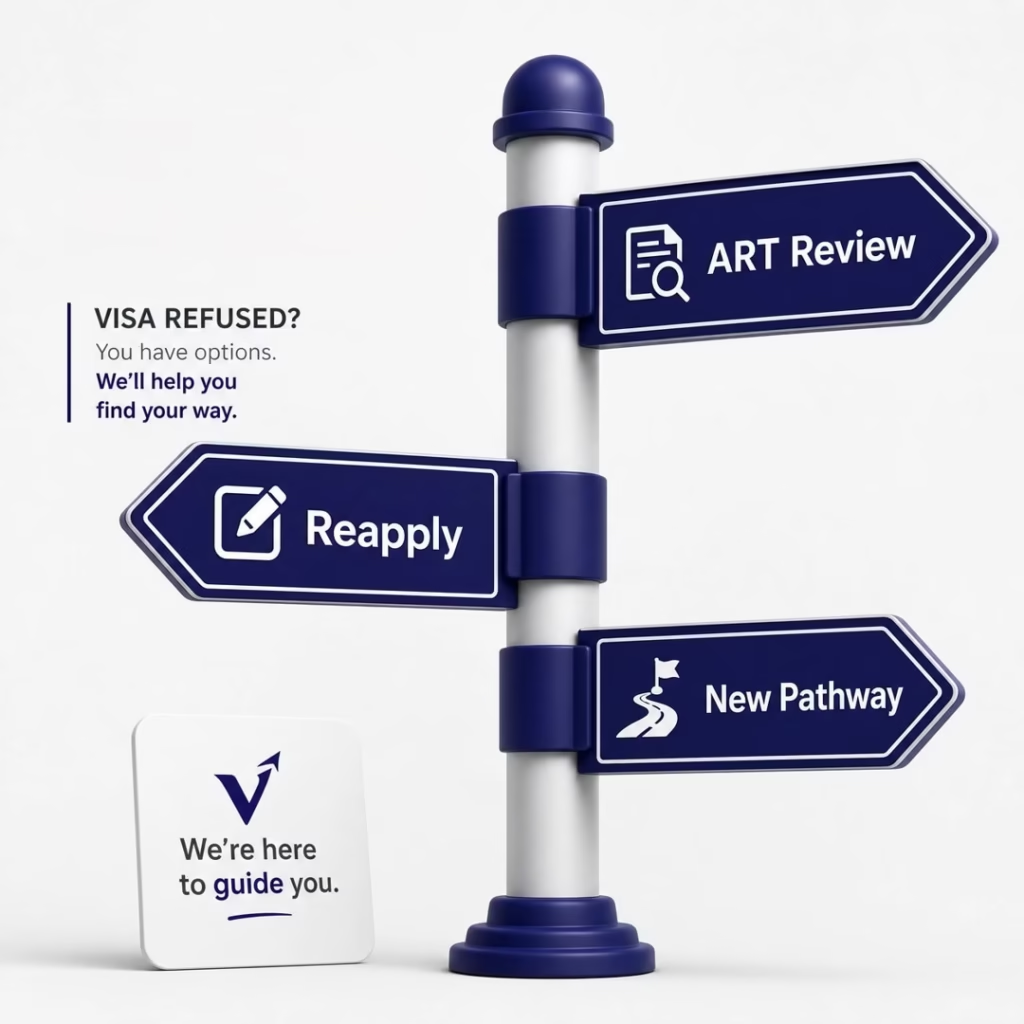
If your visa has been refused or cancelled in Australia, you may have the right to challenge that decision before an independent body — the Administrative Review Tribunal (ART). For many applicants, this is the most important option available. It keeps you in Australia while your case is reassessed, it allows you to submit new evidence, and it gives a tribunal member — not the original DHA officer — the final say on whether the decision was correct. But the ART process is not simple, and the deadlines are unforgiving. This guide walks you through every stage, from the moment you receive your refusal letter to the point where the tribunal member delivers a decision. What Is the Administrative Review Tribunal (ART)? The Administrative Review Tribunal is Australia’s independent federal body that reviews decisions made by government agencies — including visa refusals and cancellations made by the Department of Home Affairs (DHA). It commenced operations on 14 October 2024, replacing the former Administrative Appeals Tribunal. The ART is not a court. It does not ask whether the DHA officer who refused your visa was reasonable. It conducts what is known as a merits review — the tribunal member stands in the shoes of the original decision-maker and decides the case again, entirely on its own assessment of the facts, evidence, and law. That distinction matters enormously. It means you get a genuine second look, not just a procedural check. Critically, the ART can consider evidence that was not part of your original application. If there were documents you didn’t include the first time, or if your circumstances have changed since the original decision, the ART can take all of that into account. The ART covers migration decisions across Australia. Hearings can be conducted in person, by video, or by phone — so where you are located does not prevent you from accessing the process. Step 1: Check Whether Your Decision Is Reviewable Not every visa refusal or cancellation can be reviewed by the ART. The Migration Act 1958 specifies which decisions carry review rights and who is eligible to apply. Your refusal letter from the DHA will tell you explicitly whether a merits review is available. If it does not mention review rights, that is generally a sign that no merits review pathway exists for your decision type. As a broad guide, reviewable decisions typically include: Most onshore partner visa refusals and cancellations Many skilled migration visa refusals Employer sponsorship and nomination refusals Some student visa refusals Character-based cancellations under section 501 of the Migration Act Citizenship refusals Non-reviewable decisions commonly include visitor visas lodged offshore (unless family-sponsored by an Australian citizen or permanent resident), certain ministerial decisions, and some fast-track protection visa pathways. Who can lodge the application also varies. If you were in Australia (onshore) when the decision was made, you generally apply yourself. If you were offshore at the time, it is typically your Australian-based sponsor, nominator, or relative who must lodge the ART application on your behalf. For employer-sponsored visa refusals, it is usually the sponsoring business that applies. Read your refusal letter closely. This information will be on it. Step 2: Know Your Deadline — And Treat It as Absolute This is the step that trips up more applicants than any other. For most migration decisions, you have 21 days from the date you are notified of the refusal to lodge your ART application. The exact deadline will be stated in your refusal letter. Do not assume it is always 21 days — some decisions carry shorter windows: Character-based cancellations under section 501: as short as 9 days if you are in Australia Immigration detention: 14 working days from the date of notification Some other decision types: 28 days The notification date is also precisely defined. If the DHA sent the decision by email, you are notified on the day you receive it. If sent by post, you are deemed notified 7 working days after the date on the letter. These deadlines are absolute. The ART has no discretion to extend them. Missing the deadline by a single day means your review rights are permanently gone, regardless of the strength of your case. If you are running close to the deadline and your documents are not yet fully assembled, lodge the application anyway — you can submit additional evidence and submissions afterwards. Not sure whether you have review rights or how long you have? See our overview of what happens after a refusal: Options, deadlines and next steps after visa refusal Step 3: Lodge the ART Application Once you have confirmed your review rights and your deadline, the next step is lodging the application. How to apply: The easiest and most reliable way is online through the ART’s website. You can also apply in person at an ART registry or by post, though online lodgement gives you automatic confirmation and the ability to track and manage your case. What to include when lodging: A copy of your DHA refusal or cancellation letter The completed application form (available on the ART website) Payment of the application fee (or a fee reduction application, if applicable) Any initial supporting documents — though additional evidence can be submitted later Application fees (as of July 2025): Decision type Fee Most migration visa reviews $3,580 Financial hardship reduction $1,790 (50% reduction) Protection visa refusals No upfront fee; $2,203 if unsuccessful Bridging visa cancellations resulting in detention No fee If the ART sets aside the decision in your favour, you are entitled to a 50% refund of the fee paid. Fees are indexed to inflation and updated on 1 July each year — confirm the current amount at the time you lodge. If paying the full fee would cause severe financial hardship, you can apply for the 50% reduction by submitting a fee reduction form and supporting financial documents at the time of lodgement. Step 4: The DHA Provides Its Review File Once your application is lodged and accepted, the ART
For many skilled professionals, the Subclass 407 Training Visa is a fantastic way to get a foot in the door of the Australian workforce. However, the 407 is a temporary solution designed for professional development. To secure a long-term future and a path to permanent residency, the logical next step is the transition from 407 to 482 visa (the new Skills in Demand visa). At Visa Store Australia, we specialize in building these bridges. We’ve helped countless trainees move from their training plans into full-time, sponsored roles. In this guide, we’ll explain the 407 visa to 482 requirements, the costs involved, and how to time your move to ensure you don’t lose a single day of your journey toward PR. 1. The Bridge Strategy: Why Move to the 482? The 407 visa is restricted—you are there to learn, not just to work. The 482 visa, however, is a full work visa. It offers higher pay, more flexibility, and most importantly, it officially starts your 2-year countdown to permanent residency. If you have been performing well during your training, your employer is likely keen to keep you. Moving to the 482 is the best way to turn a training opportunity into a career reality. 2. The 2-Year Experience Hurdle: Does 407 Time Count? The #1 question we get is: “Does my work on a 407 visa count as experience for the 482?” The answer is: Yes, but with a catch. To qualify for the 482 visa, you generally need two years of full-time work experience in your occupation. The Department of Home Affairs can count the time you spent on your 407 visa, provided the work was performed at the required skill level and was not purely classroom-based training. At Visa Store, we can help you audit your 407 training logs and reference letters to ensure the Department sees your training as relevant work experience. 3. Employer Requirements: Shifting the Sponsorship Your employer also has some homework to do. To move you from a 407 to a 482, they must shift from being a Temporary Activities Sponsor to a Standard Business Sponsor” (SBS. The SBS License: If your boss doesn’t already have an SBS license, they will need to apply for one. The Nomination They will need to lodge a new nomination for your 482 role, which includes the Labour Market Testing (LMT) – you can learn more about it in our other guide here. The SAF Levy: Your employer will need to pay the Skilling Australians Fund (SAF) levy for the 482 visa, which is a different calculation than the 407 fees. 4. Requirements Checklist: 407 to 482 To successfully apply for a 482 while on a 407 visa, you must meet the following: Occupation Check: Your role must be on the relevant Skills in Demand occupation list. English Language: You will likely need to sit a new English test (PTE or IELTS) to meet the higher 482 standards. Skills Assessment: Depending on your occupation, you may need a formal skills assessment if you didn’t have one for your 407. 5. The Financial Breakdown: Cost of Moving The cost of moving from 407 to 482 is an investment in your future. While the employer handles the sponsorship and nomination fees, the applicant usually covers the visa charge. Visa Application Charge (VAC): Expect to pay approximately $3,035 for the main applicant. Family Members: Adding a partner or children will increase the cost – see our sponsorship visa cost guide for a full breakdown. Health & Police Checks: You may need updated medical exams if your previous ones are more than 12 months old. 6. Timing and Bridging Visas Q: Can I apply for a 482 while on a 407 visa? A: Absolutely. In fact, timing is everything. If you lodge your 482 application before your 407 expires, you will move onto a Bridging Visa A (BVA). This allows you to keep working for your sponsor with full work rights while the Department processes your new visa. Expert Tip: If you need to travel during this transition, you’ll need a Bridging Visa B (BVB). Don’t leave the country without one, or you might find yourself stuck outside Australia! Ready to Upgrade Your Career? Transitioning from a training visa to a full work visa is a major milestone. It signals to the government—and your employer—that you are a vital part of the Australian workforce. At Visa Store Australia, we provide a transition audit specifically for 407 holders. We’ll review your experience, check your employer’s eligibility, and give you a clear green light on when to lodge. Move from Trainee to Essential Staff – visit our contact page to book your 407 to 482 transition audit with one of our registered migration agents. ALSO READ: A guide to sponsoring employees for Australian PR visa How to transition from 482 visa to PR visa How to sponsor an employee for a work visa Australian sponsorship visa requirements How much does visa sponsorship cost in Australia?
For many temporary workers in Australia, moving from a 403 visa to a 482 visa represents more than a simple visa change—it is the shift from a short-term placement to a long-term professional future. This transition can unlock stronger employer sponsorship, improved earning potential, and the first real step toward permanent residency. Understanding the legal hurdles, eligibility rules, and timing is essential to making the move successfully. 1. The International Relations Shift: What Changes? Moving from a 403 to a 482 visa is a shift from a government or international agreement to a Private Standard Business Sponsorship. On a 403 visa, your rights and obligations are often tied to a specific treaty or labor scheme (like PALM). On a 482 visa, you are sponsored by an Australian business based on your specific professional skills. This move not only offers potentially higher wages but also officially starts your 2-year countdown to Permanent Residency. 2. The No Further Stay Hurdle: Solving Condition 8503 The biggest obstacle in a 403 visa to 482 transition is Condition 8503 (No Further Stay). Many 403 visas are granted with this condition, which legally prevents you from applying for another visa while you are still inside Australia. Expert Insight: The 8503 Waiver: Don’t panic if your visa has this condition. At Visa Store, we help clients apply for an 8503 Waiver. If you can show that your circumstances have changed or that there are compelling reasons for you to stay and contribute your skills to an Australian business, the Department of Home Affairs may waive the condition, allowing you to lodge your 482 application on-shore. 3. The PALM Scheme Opportunity If you are a worker under the Pacific Australia Labour Mobility (PALM) scheme, you have already proven your work ethic and ability to adapt to the Australian workforce. Many regional employers are eager to move their best PALM workers onto a 482 visa to keep them in the business long-term. To make this move, you must ensure your new role fits within the Skills in Demand occupation lists. We work with both workers and regional employers to audit these roles and ensure the transition is compliant with both the PALM scheme rules and migration law. 4. Requirements & Skills Audit: Do You Qualify? To successfully change from 403 to 482 visa, you must meet the standard 482 criteria: 2-Year Experience Rule: You generally need two years of relevant work experience. We can help you determine if your time spent working under the 403 visa can be counted toward this requirement. English Language: You will likely need to sit a PTE Academic or IELTS test to prove you meet the “Competent English” standard required for the 482. Employer Sponsorship: Your employer must be (or become) an approved Standard Business Sponsor (SBS). 5. The Financial Blueprint: Cost of the Move The cost of a 403 to 482 transition includes several layers: Waiver Fees If you need an 8503 waiver, there is a process involved (though the Department does not charge a fee for the waiver request itself, professional assistance is highly recommended). Visa Application Charge (VAC: The main applicant fee for the 482 visa is approximately $3,035. Employer Costs: Your employer is responsible for the Nomination fee ($330) and the SAF Levy ($1,200 – $1,800 per year). For a full breakdown of family costs and health exams, see our updated visa cost guide. 6. Bridging the Gap Safely Timing is everything. You must remain lawful at all times. If your 8503 waiver is approved and you lodge your 482 application, you will move onto a Bridging Visa A (BVA). This allows you to stay in Australia while your new visa is processed. However, you must continue to follow your 403 visa conditions until the 482 is officially granted. Take the Next Step Toward Your Career The 403 visa was your entry point into Australia, but the 482 visa is your future. Because this transition involves international agreements and potential legal bars, it is not something you should attempt alone. At Visa Store, we offer a 403 pathway review – we’ll check your visa conditions, assess your 8503 waiver chances, and map out a clear path to your new career. Turn your international experience into an Australian career. Visit our contact page to book your review. Let our OMARA registered migration agents handle the complex legal hurdles while you focus on your future. ALSO READ: A guide to sponsoring employees for Australian PR visa How to transition from 482 visa to PR visa How to sponsor an employee for a work visa Australian sponsorship visa requirements How much does visa sponsorship cost in Australia?
When planning a move to Australia—or preparing to hire overseas talent—the most important question is usually the financial one: what is the real sponsorship visa cost in Australia? The answer is rarely straightforward. Australian sponsorship visa costs are not a single figure. Instead, they combine government charges, compulsory levies, and personal expenses, all of which vary depending on the visa subclass and the size of the sponsoring business. At Visa Store Australia, we believe transparency around costs is essential to building a successful migration journey. This guide has been designed as a clear, detailed breakdown of the expenses linked to the: Skills in Demand visa (Subclass 482) Employer Nomination Scheme visa (Subclass 186) Regional Sponsored visa (Subclass 494) Whether you are an employer budgeting for recruitment or a professional relocating to Australia, this resource will help ensure there are no unexpected financial surprises. 1. Who Pays What? Legal Rules & Ethical Responsibilities Before looking at specific figures, it is critical to understand the legal framework governing sponsorship costs in Australia. The Department of Home Affairs strictly regulates who can pay certain expenses to prevent worker exploitation. Employer obligations Australian law clearly states that employers must not transfer sponsorship-related costs to the employee. This includes: Standard Business Sponsorship (SBS) costs Nomination fees The Skilling Australians Fund (SAF) levy Attempting to recover these costs—whether directly or indirectly through salary deductions—can result in serious penalties, fines, and loss of sponsorship rights. Employee responsibilities In most situations, the employee is responsible for: Their visa application charge Fees for partners or children Medical examinations English language testing That said, many competitive Australian employers choose to cover some or all of these costs as part of a relocation or employment package to secure highly skilled candidates. Migration agent professional fees Who pays migration agent fees is usually determined through individual negoti.ation For employers: At Visa Store Australia, we provide free 30-minute consultations for Australian businesses to map out sponsorship strategies with no upfront cost. For employees: Professional fees vary depending on case complexity and the migration agent involved. Some employers cover these costs, while many applicants prefer to pay independently to ensure their personal and family interests are fully represented. 2. Employer Costs: Sponsorship and Nomination Investment For Australian businesses, the cost of sponsoring an employee typically falls into three core categories: Fee Type 482 (Skills in Demand) 186 (ENS) 494 (Regional) Sponsorship Fee (SBS) $420 (valid 5 years) N/A N/A Nomination Fee $330 $540 $0 SAF Levy – Small Business $1,200 per year $3,000 once $3,000 once SAF Levy – Large Business $1,800 per year $5,000 once $5,000 once A small business is defined as having annual turnover below $10 million. For the 482 visa, the SAF levy must be paid upfront for the full visa period. For example, a four-year 482 visa sponsored by a small business requires a $4,800 SAF payment. 3. Applicant Costs: Visa Application Charges (VAC) Visa application charges are paid directly to the government and increase when dependants are included. Visa Subclass Main Applicant Partner (18+) Child (<18) 482 $3,035 $3,035 $760 186 (Permanent) $4,710 $2,355 $1,180 494 $4,710 $2,355 $1,180 Expert insight: adding family later If family members are added after the main visa lodgement—such as adding a partner to a 482 visa—they are treated as subsequent entrants. While the base government charge remains similar, this approach can lead to longer processing times and potential additional secondary costs. For this reason, including family members in the initial application is usually the most efficient and cost-effective pathway. 4. Hidden Costs Many Sponsorship Visa Guides Miss Beyond official government fees, several mandatory but often overlooked expenses can significantly affect the total sponsorship visa cost in Australia. Second instalment English fee: For 186 and 494 visas, if a dependant cannot demonstrate Functional English (around IELTS 4.5 equivalent), a second instalment fee of $4,890 must be paid before visa grant. This fee funds government-supported English classes in Australia. Bridging visa travel costs: Applicants in Australia typically transition to a Bridging Visa A (BVA) while their visa is processed. If overseas travel is required during this time, a Bridging Visa B (BVB) is needed, costing about $190. NAATI document translations: Non-English documents must be translated by a NAATI-certified translator, usually adding $500–$1,000 depending on document volume. Skills assessments and medical examinations: Typical costs include: Skills assessment: $800–$2,500 Medical exams: approximately $350–$500 per person These expenses are essential for a valid visa application but are often overlooked during early budgeting. 5. Regional Pathway Savings: The 494 Visa Advantage The 494 visa can offer cost benefits in specific areas. While employers must still pay the $3,000–$5,000 SAF levy, the nomination fee is $0, reducing upfront government charges. However, most regional nominations require endorsement from a Regional Certifying Body (RCB), which usually charges an administrative review fee of $300–$700. 6. The Real Financial Risk: Visa Refusal One of the most significant—and frequently underestimated—costs is application refusal. If a nomination is refused due to technical errors (for example, mistakes in Labour Market Testing), the SAF levy is generally not refunded. For large businesses sponsoring through the 186 visa, this could mean an immediate $5,000 loss. This is why professional migration assistance should be viewed not simply as a service, but as financial risk protection for both employers and applicants. Get Clarity on Your Sponsorship Visa Costs Every migration journey is different, and guessing the costs can be risky. Speak with our team to receive a transparent, personalised cost breakdown for your specific sponsorship visa, with fixed fees and expert guidance from the start. Visit our contact page now to secure your appointment. ALSO READ: How to sponsor an employee for a work visa Australian visa sponsorship requirements A guide to Australian permanent residency sponsorship Sponsorship visa for aged care workers in Australia
In the world of global business, talent is the ultimate currency. While temporary visas are great for solving immediate gaps, permanent residency sponsorship is the ultimate tool for long-term stability and growth. By offering a path to PR, you aren’t just hiring an employee; you are securing a dedicated expert who is committed to your company’s future in Australia. At Visa Store Australia, we help businesses move beyond “temporary fixes” and build “permanent solutions.” This guide focuses on the Employer Nomination Scheme (Subclass 186)—the gold standard for Australia PR sponsorship. We’ll show you how to navigate the requirements, manage the costs, and use PR as a strategic advantage for your business. Strategic PR Consultation for Employers: Sponsoring for PR involves a higher level of scrutiny from the government. That is why we offer a Free 30-Minute Consultation to help you assess your business’s eligibility for the 186 visa. Book your session here. 1. Why Sponsor for Permanent Residency? Many business owners ask, “How do I sponsor an employee for permanent residency?” and more importantly, “Is it worth the investment?” The answer lies in talent retention. When you sponsor a permanent resident in Australia, you eliminate the visa anxiety that can often distract high-performing staff. It creates a deep sense of loyalty and ensures that the skills and institutional knowledge your employee has built stay within your company for the long term. 2. Choosing Your Pathway: Direct Entry vs. Transition There are two primary ways a company can apply to sponsor an employee for a 186 visa. Choosing the right one depends on your relationship with the candidate. The Direct Entry Stream: This is a powerful poaching tool. It allows you to sponsor a highly skilled person for PR immediately even if they have never worked for you before or are currently living overseas. The Temporary Residence Transition (TRT) Stream: This is for employees who have already been working for you on a 482 visa. Note: Because the transition from a 482 visa is such a popular path, we have created a dedicated guide for it. For the specific steps on moving your current staff from temporary to permanent status, see our guide on 482 Visa to PR here. 3. Employer Eligibility: The Genuine Need Audit The 186 visa employer requirements are more rigorous than temporary visas. The Department of Home Affairs needs to be certain that your business is not only legitimate but also financially capable of supporting a permanent role. As your strategic partner, we perform a genuineness audit before we lodge. We look at: Financial Health: Does your turnover justify a permanent, full-time salary? Organizational Structure: Does the role fit logically within your team? The SAF Levy: For the 186 visa, the 186 visa cost for the employer includes a one-off Skilling Australians Fund (SAF) payment of $3,000 (for small businesses) or $5,000 (for large businesses). 4. Expert Insight: Solving the Age 45 Hurdle One of the biggest roadblocks in sponsoring employees for permanent residency is the age limit. Generally, the applicant must be under 45 years old. That said, if your ideal candidate is over 45 years old, don’t give up. There are high-income exemptions and specific pathways for researchers, scientists, and medical practitioners that can bypass this limit. If you have a senior expert you want to keep, you can get in touch with our team to discuss these strategic workarounds during your consultation. 5. The 186 Visa Checklist: What You Need to Know To ensure a successful employer nomination scheme visa subclass 186 application, both the business and the employee must meet high standards. Skills Assessment: For the Direct Entry stream, a full skills assessment is mandatory to prove the candidate is an expert in their field. English Language: The applicant must demonstrate competent English (usually a score of 50+ in PTE or 6.0+ in IELTS). Salary: You must pay at least the market rate for the role, ensuring it meets the Australian standard for that profession. 6. Why Strategy Trumps Paperwork A 186 visa application is a high-stakes move. Unlike temporary visas, a refusal here can be a massive setback for both your business and your employee’s life. This is why we don’t just lodge papers. We handle the complex 186 visa checklist for the employer, we audit the genuine position submission, and we ensure that every technical requirement—from the SAF levy to the occupation caveats—is perfectly met. We take the 25% strategic risk off your shoulders so you can focus on your business. Secure Your Team’s Future Today Sponsoring an employee for permanent residency is a sign of a thriving, forward-thinking business. Whether you are looking to hire a new global executive via direct entry or reward a loyal team member, we are here to guide you. Ready to start your PR strategy? Book a free 30-minute consultation to better understand how we can help you onboard international talent onto your team. ALSO READ: How to transition from 482 visa to PR visa How to sponsor an employee for a work visa Australian visa sponsorship requirements How much does visa sponsorship cost in Australia? How to change from 403 visa to 482 visa

For many skilled professionals, the 482 visa is the first step toward a lifelong dream: becoming an Australian permanent resident. However, for years, the path from temporary to permanent was filled with uncertainty, especially for those on the Short-Term occupation list. The latest 482 visa news has changed everything. With the 2026 reforms, the Australian government has significantly streamlined the 482 to 186 visa transition, making it faster and more accessible than ever before. At Visa Store Australia, we’ve guided hundreds of families through this transition, and in this guide, we’ll break down the new rules for 482 visa to permanent residency so you can plan your future with certainty. The 2-Year Breakthrough: When Can You Apply? The most common question we hear is: “When can I apply for PR after a 482 visa?” Under the 482 to 186 visa new rules, the waiting period has been reduced. You no longer need to wait three years. You are now generally eligible to apply for permanent residency via the Employer Nomination Scheme (Subclass 186) after working for your sponsoring employer for just two years on your 482 visa. This is a game-changer. It means you can secure your gold card a full year earlier than under the old system, providing immediate stability for your career and your family. No More Dead Ends: Short-Term vs. Medium-Term One of the biggest frustrations of the old system was the difference between 482 and 186 visa eligibility based on your occupation list. If your job was on the Short-Term list, you were often blocked from PR entirely. That has changed. The new rules for 482 visa to permanent residency have opened the 186 pathway to all 482 visa holders. Whether your occupation is Short-Term, Medium-Term, or Regional, you now have a clear, legislated path to PR as long as you meet the standard requirements and have the support of your employer. Technical Requirements for the Transition While the path is open, the 482 visa to 186 visa requirements remain technical. To successfully transition, you must satisfy several key criteria: Ongoing Sponsorship: You must still be employed by the same employer who sponsored your 482 visa (unless you have successfully managed a 482 transfer. English Language: You must demonstrate competent English. This usually means a score of 50+ in PTE Academic or 6.0+ in each band of IELTS. Health & Character: You and your family must meet the same high standards you faced during your 482 application. For a line-by-line breakdown of what these tests cost, visit our guide on Australia sponsorship visa cost. Sthe Age 45 Hurdle The 482 visa to PR age limit is a source of significant anxiety for many. Generally, you must be under 45 at the time you lodge your 186 application. However, if you are approaching 45, there are specific exemptions available, particularly for high-income earners or those covered by a 482 labour agreement to 186 visa pathway. If you are worried about the clock ticking, don’t wait—let’s audit your pathway now to see if an exemption applies to you. Book your appointment here. Labour Agreements: The Specialized Path If you are working under a Labour Agreement (common in industries like Aged Care, Meat Processing, or Dairy), your path to PR might be even more specialized. These agreements often have lower English requirements or higher age limits than the standard 186 stream. And, we can help you review your employer’s specific agreement to ensure you are taking full advantage of these benefits. The Safe Transition Strategy: Don’t Reset the Clock A critical insider tip: If you change employers while on a 482 visa, your 2-year clock for PR generally resets with the new employer. At Visa Store Australia, we act as your migration buddy to ensure your transition is safe. We help you time your applications and negotiate with your employer so that you don’t accidentally add years to your PR journey. We handle the strategic complexity so you can focus on your life in Australia. Ready to Swith Your 482 into Permanent Residency? The new rules for 482 visa to permanent residency have created an incredible opportunity, but the window of eligibility depends on perfect timing and technical accuracy. You can book your 482 to PR audit with one of our OMARA registered migration agents here. ALSO READ: A guide to sponsoring employees for Australian PR visa How to transition from 482 visa to PR visa How to sponsor an employee for a work visa Australian visa sponsorship requirements How much does visa sponsorship cost in Australia?